


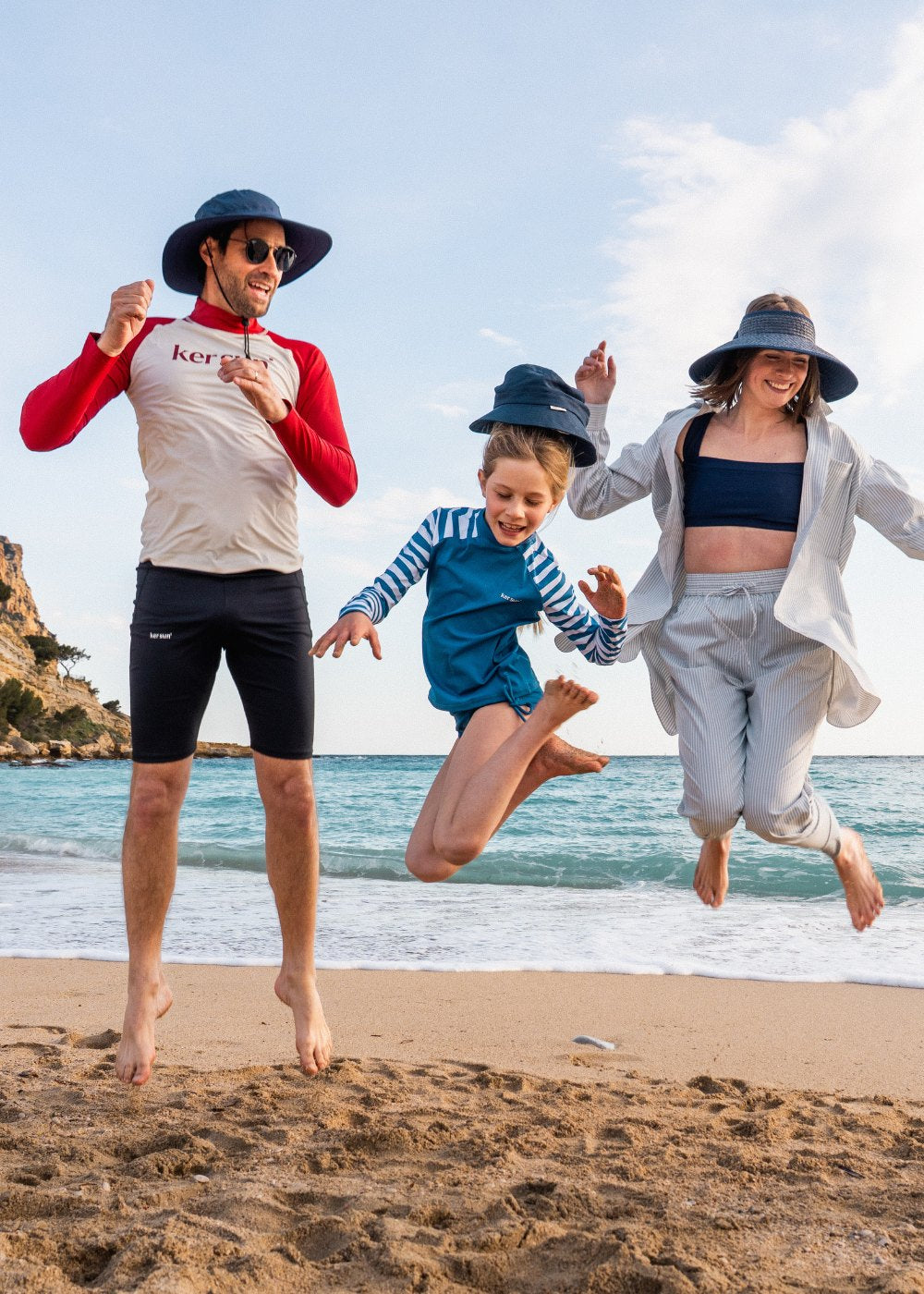
Protecting children from the sun: everything parents need to know
By Manon, pharmacist · Founder of Éclairée
“Sunscreen is enough, right?”
The question Manon, pharmacist, hears most often from parents
Children’s skin is structurally thinner, less equipped to defend itself against UV rays, and accumulates damage that sometimes only becomes visible decades later. 50% of the UV rays received over a lifetime are accumulated before the age of 20.
Few people know this figure. Yet it explains why sun protection for children is a public health issue in its own right, and why good habits adopted early make a real difference in the long term.
In this article, Manon, a pharmacist specialising in skin cancer and founder of Éclairée (Instagram page @eclaireee), explains what UV rays really do to our children’s skin, and what we can do in practical terms to protect it.

Understanding the risk
Why are UV rays more dangerous during childhood?
Sun protection for children is essential from the earliest age. Unlike adult skin, children’s skin is still immature and much more vulnerable to the effects of UV rays. A simple sunburn during childhood can have long-term consequences for the health of the skin and eyes.
Thinner, more permeable skin
The epidermis of young children is thinner than that of adults. Their skin barrier is therefore less effective at filtering UV rays. Children’s skin is also more permeable: certain substances found in cosmetic products, including some sunscreen filters, can penetrate the body more easily.
Applying sunscreen is generally not recommended for babies under 6 months, and before the age of 3 it is very strongly recommended to avoid any direct sun exposure.
Defence systems that are still immature
When skin is exposed to UV rays, the adult body has several protective mechanisms: antioxidant systems, DNA repair mechanisms and cutaneous immune defences. In children, these mechanisms are still immature and therefore less effective.
Melanocytes, the cells that enable the synthesis of melanin, the natural pigment that helps absorb some UV rays, are fewer in number and less effective in children.
Finally, the risk of heatstroke is higher in children because their thermoregulation systems are less effective. It is therefore very important to check that they are hydrated and not to expose them to the sun for long periods.
The danger of sunburn
Why is sunburn particularly serious in children?
Sunburn during childhood should never be taken lightly. UV rays cause damage to the DNA of skin cells. The earlier these exposures begin, the more their effects accumulate over a lifetime.
×2
One single sunburn before the age of 15 almost doubles the risk of melanoma in adulthood
50 %
of the UV rays received over a lifetime are accumulated before the age of 20
The eyes too
What are the risks for children’s eyes?
For the eyes, the main medium- or long-term risk is a loss of visual acuity due to damage to the retina (AMD) and the crystalline lens (cataract). The crystalline lens is part of the eye that enables accommodation to light and filters UV rays, but this protective role only begins from the age of 12. Before this age, children do not have effective UV filtration.
Wearing sunglasses is particularly recommended for children under 12, whose crystalline lens does not yet filter UV rays effectively.
Good habits
What is the best sun protection for a child?
To begin with, exposing children under 3 to UV rays is strongly discouraged. Shade therefore remains the best protection. When children are exposed, it is recommended to use physical sun protection to protect them as well as possible.

- Certified UPF 50+ UV protection clothing — even more than for adults, clothing is the most important protection. A standard white cotton T-shirt offers only UPF 7; a certified UPF 50+ garment filters 97.5% to 98% of UV rays.
- No direct exposure before age 3 — toddlers’ skin is extremely vulnerable; shade is the best protection.
- Category 3 sunglasses minimum — category 4 in the mountains or when the UV index is high. Essential before age 12.
- A wide-brimmed hat or bucket hat — to protect the ears and the nape of the neck, areas that are particularly exposed.
- SPF 50+ sunscreen on uncovered areas. Choose a very water-resistant product, without fragrance or alcohol. The same cream can be suitable for the whole family.
- Hydrate regularly — children become dehydrated quickly. Offer water frequently, even if they are not thirsty.
Ker Sun collections
UV protection clothing for little ones


Manon · Pharmacist, founder of Éclairée
Sun prevention for children is a major public health issue. Good habits adopted early make a real difference in the long term.
(1) Gandini S, et al. Meta-analysis of risk factors for cutaneous melanoma. Eur J Cancer. 2005 Jan;41(1):28-44. — Sun safety: sun and UV, risks during the first 1000 days.


Partager: