



Sun and skin: answers to the 10 questions patients ask
By Dr Claire Jacquin, dermatologist
Misconceptions about the sun are hard to shake. To help clarify things, Ker Sun asked for insight from Dr Claire Jacquin, dermatologist and member of the association “Dans la peau des sportifs”. In a question-and-answer format, she addresses the most frequent concerns raised by her patients and restores a few essential truths about UV rays and skin protection.
“Oh no, doctor, I never expose myself!”
I hear this sentence every day, from patients who are nevertheless tanned or who have many outdoor activities. And you, did you know that ultraviolet (UV) rays are not only present at the beach, but in all situations as soon as you are outdoors?
Did you know that these UV rays are responsible for 80% of skin cancers, including the most common cancer in the world (basal cell carcinoma), particularly in fair skin?
Question 1
Am I exposed to UV rays when I garden, hike or walk my dog?
Absolutely. UV rays are completely invisible, colourless, and are not linked to the sensation of heat (so they should not be confused with infrared rays). These rays emitted by the sun vary in strength throughout the day and the seasons: we can understand this through the UV index, which ranges from 0 to 14. From 3 upwards, the index is considered “moderate” and the risk begins: protection is therefore needed. The higher this index, the greater the UV intensity and therefore the greater the danger.
Question 2
When it is windy or cloudy, am I safe?
Well, no. It is important to remember that wind and clouds are false friends: they reduce the sensation of heat (infrared), but not UV rays at all. Clouds can let through up to 80% of UV rays, and some of them even increase their danger through the reflection they cause. That said, with heavy black clouds or rain, the UV index will still be much lower! Let us also keep in mind that altitude increases UV risk, as do highly reflective surfaces (snow, sand, etc.).
“Wind and clouds are false friends”
Question 3
My technique is to prepare my skin by tanning gradually: not bad, right?
Here again, we need to remember that tanning is a defence reaction by the body, which does indeed produce melanin to temporarily protect cells from the dangers of UV rays.
Fine, but each time these tanning mechanisms are called upon, they become depleted and progressively less effective. Over time, the “sun capital” is exhausted and the risk of carcinoma increases. In addition, a tan offers only very weak protection, equivalent to an SPF of around 2 to 4: could do better!
Question 4
What exactly does “sun capital” mean?
“Sun capital” is an image used to explain that the effects of UV rays accumulate throughout life. Every exposure (meaning every time you go outdoors) calls on invisible skin repair mechanisms, which gradually become exhausted over time (sun capital).
“ A person with very fair skin therefore has very little “reserve” and thus limited “sun capital”: the risk of skin ageing and of developing skin cancer will be all the more pronounced.”
Question 5
Does the sun also age the skin?
Of course. This time, it is mainly UVA rays that are responsible: wrinkles and brown spots in particular, and they are even able to pass through window glass. UVB rays tend instead to cause sunburn.
Question 6
Are sunburns really dangerous?
Yes. Every sunburn corresponds to the destruction of skin cells by UV rays. Repeated sunburns, especially during childhood and adolescence, durably increase the risk of melanoma, the most aggressive skin cancer.
Pay attention to children, whose skin is more fragile and whose sun exposure is generally 3 times greater than that of an adult!
Question 7
If I apply sunscreen, can I stay outside all day?
Not really. Sunscreen reduces part of the UV rays, but never blocks them completely (there is no such thing as total sunblock!). In addition, it must be applied in generous quantities (one teaspoon for the face) and reapplied regularly (every 1 to 2 hours), which is almost never done in real life. It does not replace covering clothing, a hat, or seeking shade...
Question 8
Do covering clothes make you hot and not always protect you from the sun?
This time, it depends on the type of garment! A technical, breathable UPF 50 garment will provide good ventilation, wearing comfort during sports activities, and excellent sun protection. Conversely, it is true that a thin, loosely woven, light-coloured or wet garment will let through a significant proportion of UV rays...
Question 9
Which areas are the most sensitive, where skin cancers appear most often?
The most exposed areas are the highest-risk areas: face (especially nose, ears and lips), scalp in people with thinning hair, neckline / neck, forearms, backs of the hands, and legs.
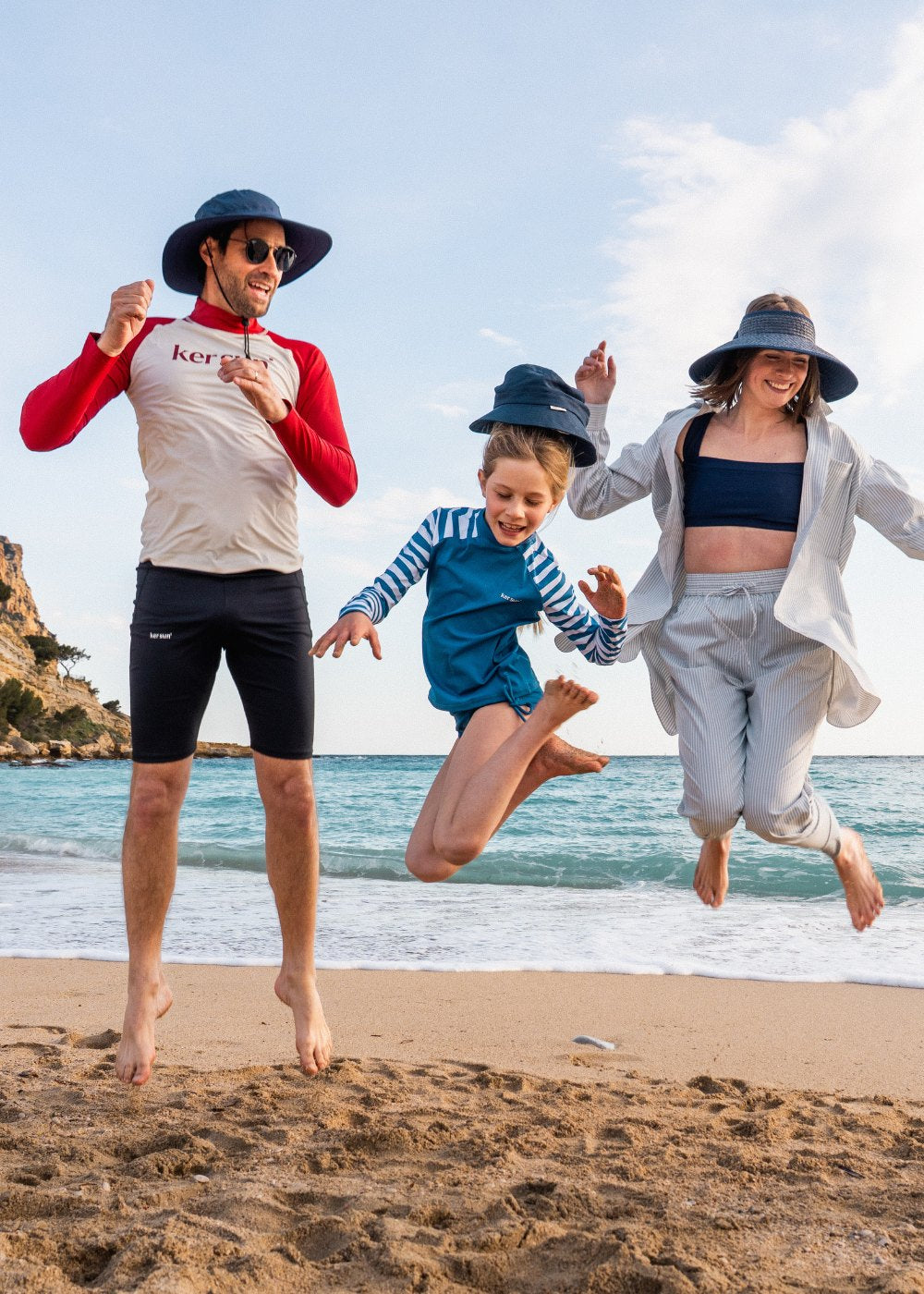
In athletes, the shoulders and upper back are generally also very exposed. The best prevention is therefore to cover these areas, with a wide-brimmed hat for the face, neck and ears, and trousers, as well as arm sleeves or long sleeves for the forearms in particular.
Question 10
I have fair skin and many moles: am I at higher risk?
Yes. The risk of skin cancer is higher in people with fair skin, and the risk of melanoma (cancer of a mole) increases from 50 moles. This means protection must be all the more rigorous!
Dr Claire Jacquin
Dermatologist · Member of the association “Dans la peau des sportifs”


Partager: